



- Written by: Eric Mingorance
- August 19, 2026
Most revenue leaders have sat in the same uncomfortable meeting. The forecast on the slide doesn’t match the forecast in the room; the board asks why the number moved again, and nobody has a clean answer. The strategy isn’t the problem. Somewhere between the conference room and the customer, execution is breaking down, and it’s breaking down differently for every rep.
That was the starting point for one high-growth-stage B2B SaaS company: five products, several acquisitions stitched together, and a global sales team assembled from a handful of different company backgrounds. There was no shared playbook, no commonly practiced methodology, and a forecast built mostly on gut feel. Reps were getting first meetings, but rarely second ones. They could spot a prospect’s broken toolset or workflow inefficiency, then jumped straight to product features, without ever confirming the business impact was big enough to justify a budget decision. Deals didn’t die to competitors. They died slowly to “no decision.”
The Real Question Isn't Whether the Event Went Well
The CRO was aligned from the start, and he understood something that many leaders miss: the company needed a real enablement function, not a one-day workshop. Behavior change is a journey, not an event. A single training session, no matter how well delivered, cannot override months or years of inconsistent habits across a sales team with wildly different backgrounds and skill levels.
So the engagement didn’t start with a framework. It started with a Gap and Friction Analysis — structured conversations with the strongest reps and the newest BDRs, input from RevOps and channel partners, and a hard look at the marketing collateral and knowledge repositories already scattered across the five product lines. That work surfaced exactly where the motion was breaking down, and where the team had both the biggest opportunity and the real appetite to improve.
Over two quarters, the standardized motion was built with the team, not handed down to it. That pacing was deliberate. Rushing a methodology into place produces compliance for a week and drift for a year. Taking the time to coach, support, and reinforce produces something that survives contact with a real pipeline.
A Foundation Deals Couldn't Talk Their Way Past
The foundation came first. Deal stages were rebuilt around real exit criteria, so opportunities could no longer advance on optimism alone. The team was anchored to a single, shared standard for qualifying, using MEDDPICC as a consistent way to answer why change, why now, and why us, applied the same way by every rep, regardless of tenure or which acquired company they’d come from.
A shared language is easy to announce in a kickoff meeting and just as easy to forget by the following week. What made this one different was how consistently it showed up in the actual daily motion:
A deal sheet built into the CRM, so the qualifying questions lived in the tools reps already used every day, not in a slide deck they filed away after the rollout.
Deal reviews conducted directly off that deal sheet. If the qualifying questions weren’t answered, the review call was staring at a blank deal sheet. It did not stay blank for long.
The standard was reinforced in forecast calls, deal reviews, and one-on-ones, so reps encountered it from every direction: the tools they worked in, the managers coaching them, and the leadership team above them.
From Workflow Complaints to Business Impact
The standard gave the team a shared structure. The coaching is what changed rep behavior within it.
Reps were treating end users who wanted a new tool as if they were champions, and stopping at surface-level pain. The coaching pushed past that instinct: “I’d save three hours a day” is not business impact. The real questions are what the business does with that time, why the end user’s boss would care, and which company priority it ladders up to.
That shift, from cataloguing workflow complaints to articulating measurable business impact, is what turned first meetings into second meetings.
The Manager Layer Is Where It Sticks or Dies
Most enablement rollouts don’t fail in the training room. They fail in the layer just above the rep. As the CRO put it, “if the frontline leaders aren’t pulling it through, it’s never going to work.”
Managers were equipped with rubrics and resources to reinforce the standard in every review, which is exactly why the methodology held after the formal engagement ended. The standard wasn’t a program that ran alongside the business. It became how the business already operated, in the deal sheet, in the forecast call, in the one-on-one.
The Result: A Forecast the Board Could Trust
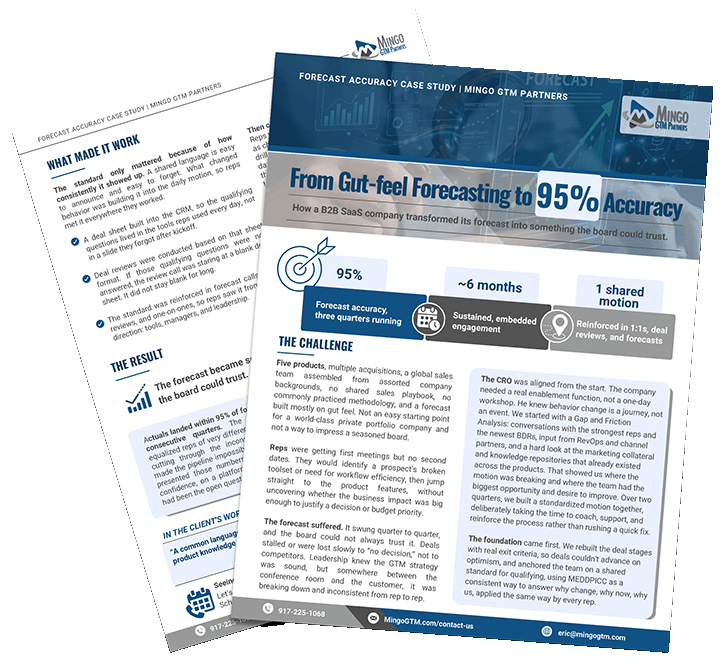
Actuals landed within 95% of forecast for three consecutive quarters.
The shared motion equalized reps of very different tenure and skill, cutting through the inconsistency that had made the pipeline nearly impossible to read. The CRO was able to present those numbers to the board with confidence, on a platform where predictability had previously been the open question.
Why It Worked
Two conditions made this the right answer for this team. The fundamentals were already sound; there was real product-market fit and a real pipeline, and deals were being lost to “no decision,” not to competitors. The methodology fit because it matched the actual problem on the ground, not because any single framework is a cure-all.
And it worked because the person at the top wanted it to. The CRO didn’t outsource the change and walk away; he sponsored it, amplified it, and held the line in his own deal reviews and forecast calls. That is consistently the difference between a methodology that drifts and one that becomes how a team actually works: reinforcement and accountability from the top down.
“A common language became the great normalizer. It let us cut through the differences in background, product knowledge, and skill, and forecast accurately.” — CRO, high-growth-stage portfolio company.
The strategy was already there. Now it is being executed consistently.
Download the case study HERE